Fabric Gift Wrapping: How to Wrap a Gift in Cloth
Learn how to wrap a gift in a square of cloth with no tape: choosing fabric, working out the size, folding the corners over a box and tying a flat square knot, plus versions for books and bottles.
Tutorial at a glance
Materials
- Square of cotton or linen cloth
- Pinking shears or fabric scissors (if cutting your own square)
- Iron for pressing
- Gift tag and twine
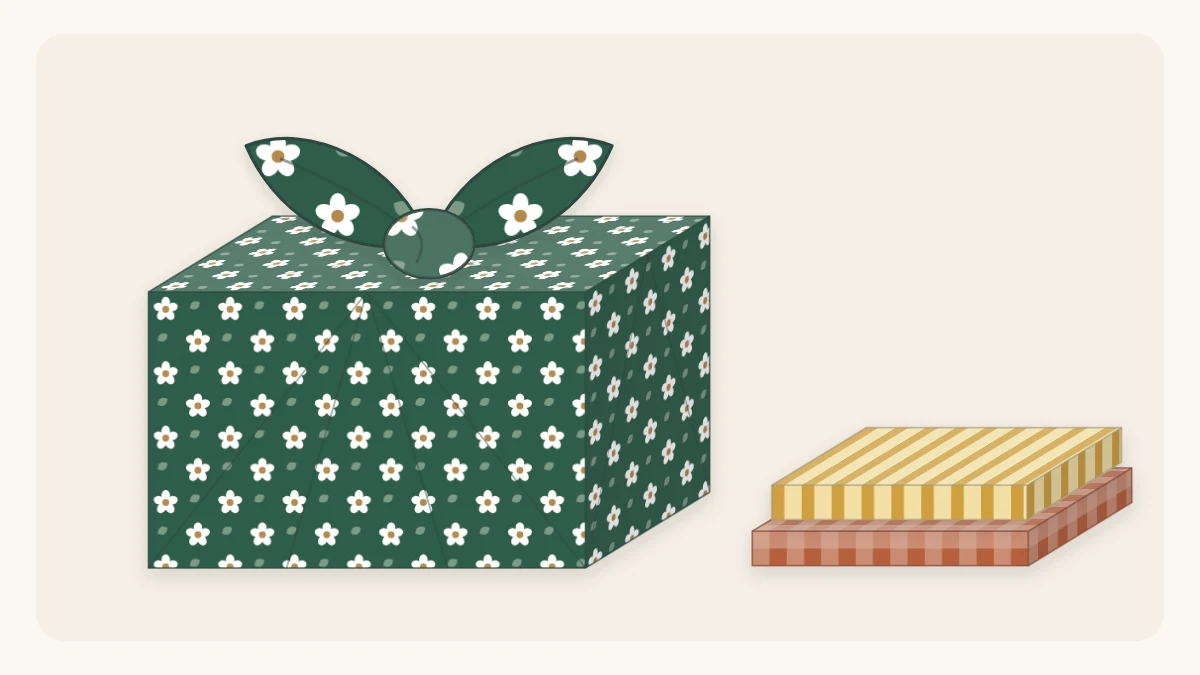
Fabric gift wrapping swaps paper and tape for a square of cloth and a knot. You set the gift in the middle, fold the cloth around it and tie the corners on top. Nothing is cut to size and nothing is stuck down, so the wrap comes off in seconds and can be used again.
It is also one of the most forgiving ways to wrap. Cloth does not tear at corners or hold a wrong crease, and if the first attempt looks lopsided you simply untie it and try again. Japan has a long tradition of wrapping cloths called furoshiki; the method here is the same general idea of a knotted square.
Choosing the fabric
Thin, soft, woven fabrics that are not slippery knot best. Cotton and linen are the easiest to work with. A square scarf, a bandana, a thin cotton towel or a cut piece from a fabric remnant will all do the job.
| Fabric | How it knots | Good for |
|---|---|---|
| Light cotton | Easily, holds firm | Most gifts |
| Linen | Well, slightly bulky | Medium and large boxes |
| Silky or satin cloth | Slips loose | Light gifts, tied twice |
| Thick or stretchy cloth | Bulky, hard to tie | Best avoided |
Patterns behave differently on cloth than on paper, because the fabric gathers into folds. Small, all-over prints and plain colors look tidy however they fall. Large pictures tend to disappear into the knot.
What size of cloth you need
The cloth must be square. For a box, a good guide is a square whose diagonal, measured corner to corner, is roughly three times the longest side of the box. For a box 8 in (20 cm) long, that means a diagonal of about 24 in (60 cm), which is a square of roughly 17 in (43 cm) per side.
Tall boxes need more fabric than flat ones, so always test before you commit: set the gift in the center and lift two opposite corners. They should meet above the gift with enough length left to tie.
Tip
If the cloth is slightly too small, turn the box so it sits more exactly on the diagonal, or choose a thinner fabric. Thin cloth uses less length in the knot.
How to wrap a box in cloth
- Lay the cloth out as a diamond, wrong side up, with one corner pointing toward you. Smooth it flat.
- Place the box in the center, diagonally, so its corners point to the sides of the cloth and its long sides face the near and far corners.
- Fold the near corner over the box. Pull it snug across the top and tuck the tip underneath the far side of the box.
- Fold the far corner over the box toward you, covering the first layer. If the tip hangs past the edge, fold it under so the edge is neat.
- Gather the two side corners. At each end of the box, pinch the cloth together close to the box so it forms a neat tail, and bring both tails up to the top.
- Tie a square knot. Cross right over left and pull snug, then cross left over right and pull again. The knot should sit flat on the center of the top.
- Arrange the ends. Spread the two tips out like the tails of a bow, or tuck them under the knot for a compact finish.
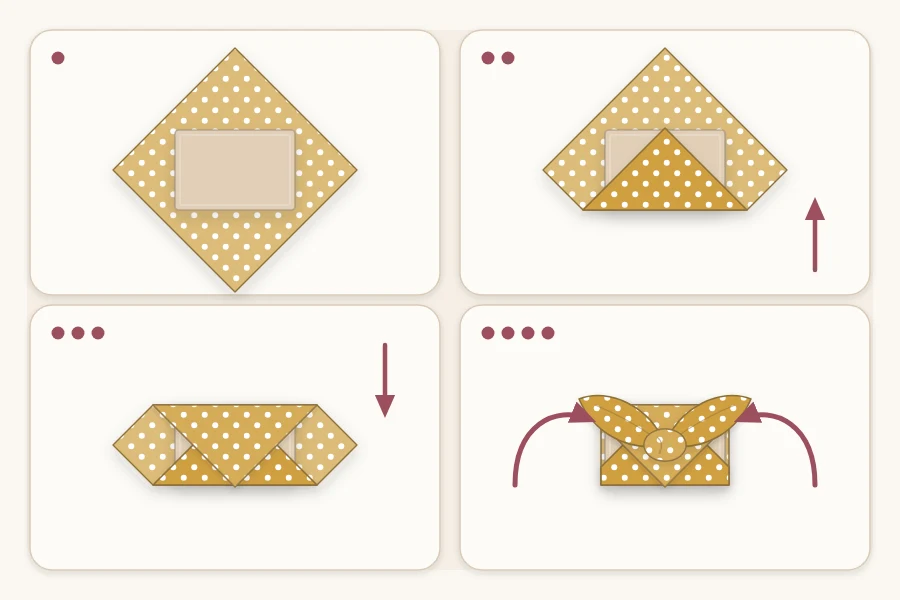
The square knot matters. Tying the same direction twice gives a knot that twists sideways and works loose. Reversing the second half makes the knot lie flat and hold.
Other shapes: books and bottles
Cloth follows shapes that paper struggles with, which makes it a handy fallback for awkward gifts.
A flat book
A book is thin, so a smaller cloth is enough. Follow the box method, and the two side corners will reach each other easily, giving one small knot in the center of the cover. If you prefer paper for books, the method is in how to wrap a book.
A bottle
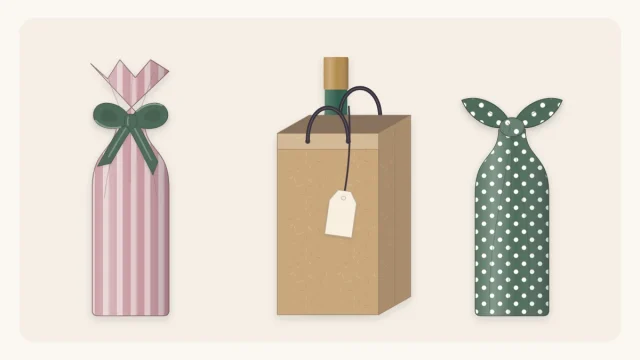
Stand the bottle in the center of the cloth. Tie two opposite corners together above the cap, then take the other two around the neck in opposite directions and knot them at the front. The steps, along with two paper alternatives, are in how to wrap a bottle.
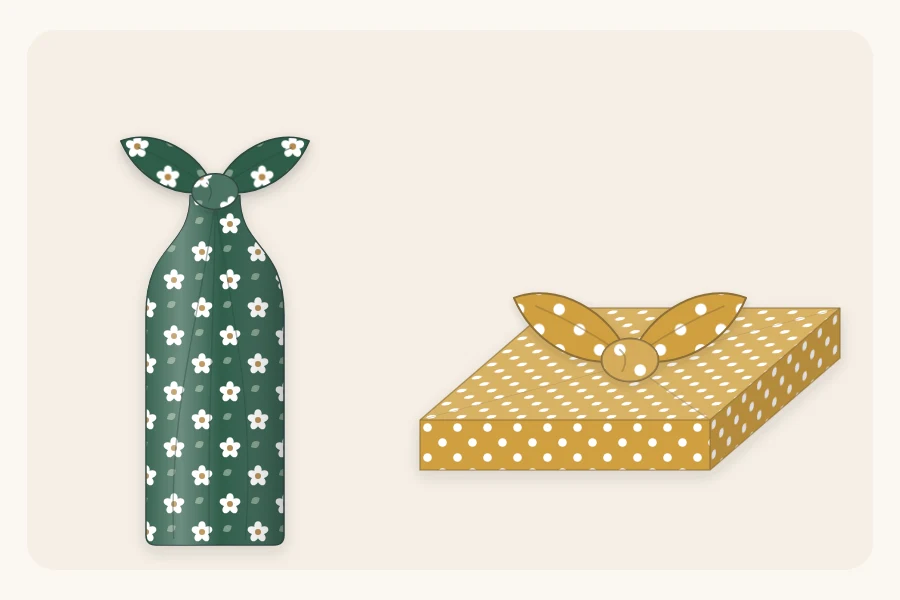
For round or soft gifts, simply gather all four corners above the gift and tie a ribbon around them to make a pouch.
Preparing the cloth
No sewing is needed. A raw cut edge will shed threads over time, though, so if you are cutting your own squares, choose one of these:
- Pinking shears. The zigzag cut slows fraying and takes moments.
- A simple hem. A narrow folded hem, stitched or held with iron-on hemming tape, lasts the longest.
- A ready-made square. Bandanas, handkerchiefs and scarves already have finished edges.
Press the cloth before you start. Creases from storage show clearly on a flat top face, and a quick iron makes any fabric look more deliberate.
Watch out
Fabric scissors and pinking shears are sharp, so children should have adult help with cutting. Follow the care label when ironing, and keep loose ribbon and small toppers away from babies and pets.
Adding a tag or topper
The knot is the decoration, so the wrap needs very little else. A tag is still useful, because a cloth-wrapped gift has no flat paper to write on. Write the names first, thread the tag onto a short length of twine and loop it around the base of the knot. The lark’s head loop described in how to attach a gift tag holds it securely.
Fixing common problems
- The knot keeps slipping. Check that it is a true square knot, and switch to a less slippery fabric if it still loosens.
- The corners will not reach. The cloth is too small or too thick. Use a larger square, or wrap the gift flat in paper instead.
- The wrap looks baggy. Pull each fold snug before the next one, and pinch the side tails close to the box before tying.
Fabric is one of several ways to skip the tape entirely. If you like the idea but only have paper on hand, see how to wrap a gift without tape for folded tucks and ribbon ties.
Frequently asked questions
What kind of fabric works best for wrapping gifts?
Thin, soft, woven fabrics that are not slippery are the easiest to knot, which makes cotton and linen the usual choices. A bandana, a square scarf or a thin cotton towel works well. Thick or stretchy fabric makes a bulky knot, and silky cloth tends to slide loose unless it is tied twice.
How big should the cloth be for a gift?
Use a square whose corner-to-corner diagonal is roughly three times the longest side of the box. Then test it: place the gift in the center and lift two opposite corners. If they meet above the gift with enough length to tie a knot, the cloth is large enough.
Do the edges of the fabric need to be sewn?
No sewing is required. A raw edge will fray gradually, so cutting with pinking shears or adding a narrow hem helps the cloth last through repeated use. The simplest option is a ready-made square with finished edges, such as a handkerchief or bandana.