How to Measure Wrapping Paper So You Never Run Short
Two simple measurements, around the box and along it, tell you exactly how much wrapping paper to cut. Includes a no-math method that uses the box itself.
Tutorial at a glance
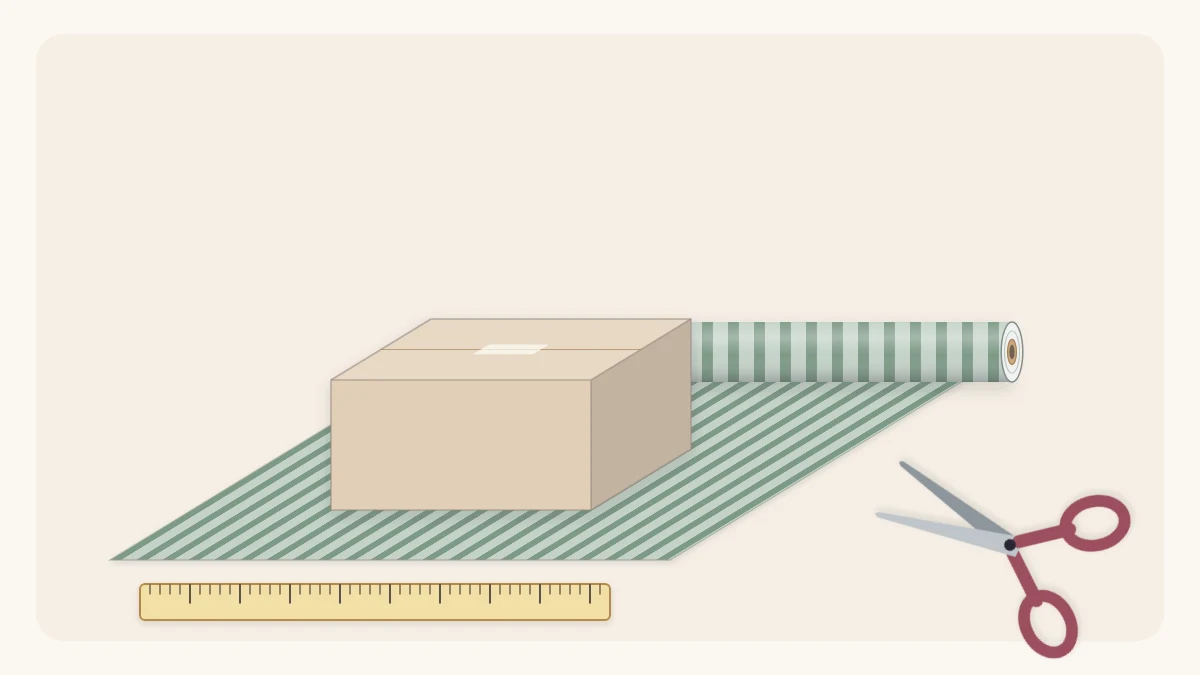
Materials
- The gift box
- Ruler or tape measure
- Pencil
- Sharp scissors
Knowing how to measure wrapping paper is the difference between a sheet that fits and one that stops an inch short of the seam. It also solves the opposite problem: too much paper, which bunches at the ends and wrinkles no matter how carefully you fold.
A box needs only two measurements, one around it and one along it. You can work them out with a ruler, or skip the numbers and let the box measure the paper for you.
The two measurements that matter
Think of the paper as a tube that goes around the box, with open ends that fold shut.
- Around the box: the paper must circle the box once and overlap itself slightly.
- Along the box: the paper must cover the length and stick out far enough at each end to fold closed.
Decide first which way the box will lie. The seam normally runs along the bottom, down the length of the box, so the longest side of the box usually runs along the roll.
Measure around the box
The distance around the box is called the girth. It is twice the width plus twice the height. Add about 2 in (5 cm) to that for the overlap.
For a box about 10 in long, 7 in wide and 3 in high (25 x 18 x 8 cm), the girth is 7 + 7 + 3 + 3 = 20 in (about 52 cm). With the overlap, the paper needs to be about 22 in (57 cm) in that direction.
The overlap is not waste. Part of it is folded under by about 1/2 in (1.3 cm) to make a clean edge on the seam, and the rest gives the tape something to hold.
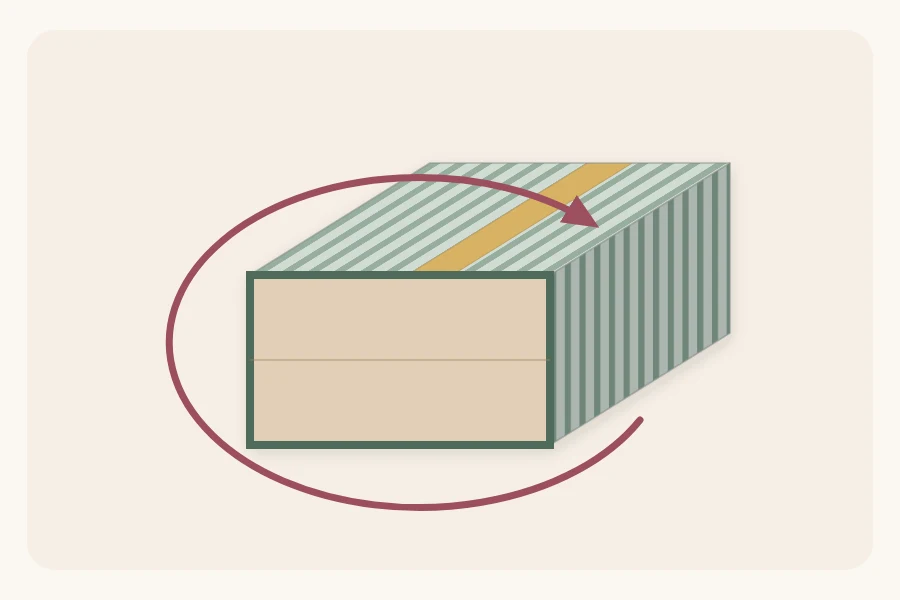
Measure along the box
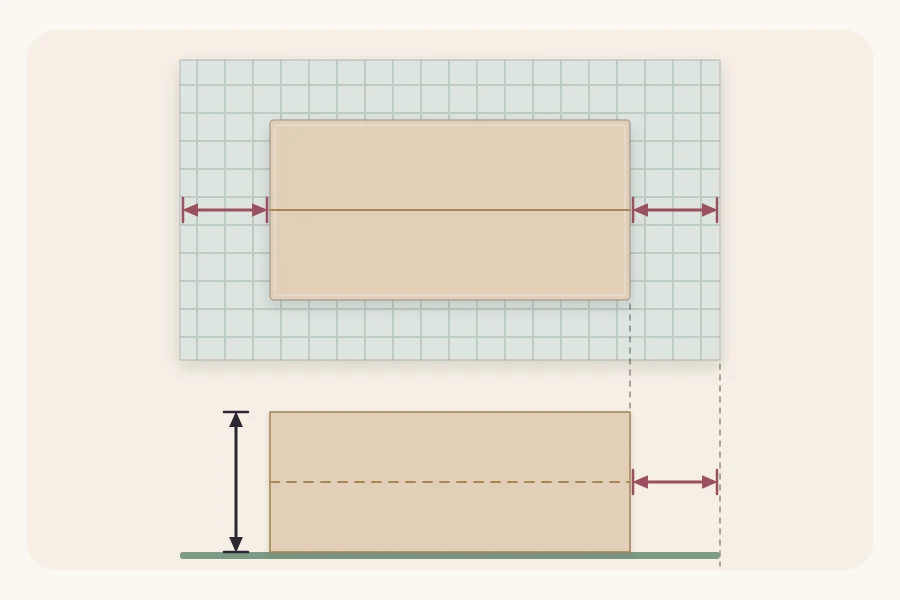
At each end, the paper has to reach a little more than halfway down the end of the box, so the flaps meet and overlap. About two-thirds of the box height at each end is a comfortable allowance.
For the same example box, the height is 3 in (8 cm), so each end needs about 2 in (5 cm). The paper should be the box length plus both allowances: 10 + 2 + 2 = 14 in (about 35 cm).
So the sheet for this box is roughly 22 x 14 in (57 x 35 cm).
Watch out
Too much paper at the ends is the main cause of bulky, wrinkled ends. If the end paper is longer than the box is tall, trim it before you fold.
The no-math method
You can get the same result without writing anything down.
- Unroll the paper pattern side down on a table. Do not cut it yet.
- Set the box near the free end of the paper, with one long side lined up along the cut edge.
- Roll the box over its four sides, one side at a time, away from the cut edge. This marks off the girth.
- Add about 2 in (5 cm) beyond where the box stops, and make a small pencil mark or pinch a crease there.
- Roll the box back and cut straight across at the mark.
- Center the box on the cut sheet and check the ends. Fold the paper up against one end of the box: it should come a little more than halfway up. Trim the side of the sheet if it reaches further.
This method works for any box and takes less than a minute once you have done it twice.
Quick reference for common box shapes
| Box shape | Around the box | Each end |
|---|---|---|
| Flat (shirt box) | Girth + 2 in (5 cm) | Very little; the flaps are thin |
| Standard rectangle | Girth + 2 in (5 cm) | About two-thirds of the height |
| Cube | Girth + 2 in (5 cm) | About two-thirds of the height, which is a lot of paper |
| Tall, narrow box | Lay it on its side, then measure as a rectangle | About two-thirds of the height as it lies |
Cubes surprise people. Because a cube is as tall as it is wide, the end allowance is large in absolute terms, and a sheet that looks generous can turn out short. Each shape has its own small adjustments, covered in how to wrap a box of any size.
Cutting a straight line
A good measurement is wasted by a crooked cut. Three things help.
- Use the grid lines printed on the back of some rolls. If you are choosing paper, the guide to types of wrapping paper explains which papers have them and which cut most cleanly.
- On paper without a grid, fold the sheet over at your mark so the side edges line up, crease the fold firmly, then cut along the crease.
- Open the scissors slightly and push them through the paper in one glide, where the paper allows it, rather than taking many small snips.
Scissors and craft knives are sharp, so give adult help to a child who is doing the cutting.
When the sheet turns out too short
A sheet that is slightly short around the box does not have to be thrown away.
- Turn the box. Rotate it a quarter turn on the sheet; the other direction may fit.
- Go diagonal. Setting the box corner-to-corner on the paper can cover a box with a sheet that is too short for the straight method. See diagonal gift wrapping for the steps.
- Cover the gap. If the edges almost meet on the bottom, tape a strip of matching paper inside the gap, or hide the gap under a wide paper band or ribbon.
Keep the offcuts either way. Strips and small pieces are useful for tags, bands and paper bows.
Check the fit before you tape
With the sheet cut, place the box upside down in the center and bring both long sides up. They should overlap by about 2 in (5 cm) in the middle of the box, and the same amount of paper should show at each end.
If everything lines up, you are ready to wrap. The full sequence is in how to wrap a gift, and the end folds are shown in detail in how to fold clean corners.
Frequently asked questions
How much should wrapping paper overlap?
About 2 in (5 cm) is a practical overlap for the seam that runs around the box. That leaves room to fold the top edge under by roughly half an inch for a clean line, with enough paper left beneath it for the tape to grip. A much wider overlap only adds bulk.
How much paper is needed at the ends of the box?
Each end needs a little more than half the height of the box, and about two-thirds of the height is comfortable. That lets the flaps meet and overlap slightly when folded. If the paper at one end is longer than the box is tall, it is too much and should be trimmed.
Can you measure wrapping paper without a ruler?
Yes. Place the box on the unrolled paper and roll it over its four sides to mark off the distance around it, then add a couple of inches for the overlap and cut. For the ends, fold the paper up against the box and check that it reaches just past halfway.